Concrete Traversals
While the Generic Templates provide immense power and flexibility, setting up the visited arrays, predecessor maps, and standard predicates manually for simple tasks can be overly verbose.
To solve this, CPP-GL provides concrete traversal algorithms: Breadth-First Search (BFS) and Depth-First Search (DFS). These functions act as lightweight, zero-cost wrappers around the core generic engines. They automatically allocate and manage the necessary state-tracking containers while still allowing you to inject custom logic via pre_visit and post_visit hooks.
Shared Behaviors and Mechanics
All concrete traversals in CPP-GL share a unified design philosophy regarding return types and component handling.
The Result Discriminator
By default, concrete traversals are designed to build a traversal tree. However, sometimes you only want to traverse a graph for its side effects (e.g., printing node names) without paying the memory allocation cost of building a predecessor map.
You can explicitly control this using the template's Result discriminator:
- gl::algorithm::ret (Default): The algorithm allocates and populates a predecessors_map. It returns
std::vector<id_type>where each index holds the ID of the vertex that discovered it. - gl::algorithm::noret: The algorithm executes purely for side effects. The predecessor map is completely optimized away at compile time, and the function returns
void.
Handling Disconnected Components
Graphs are not always fully connected. The traversal wrappers gracefully handle this using the root_vertex_id parameter:
- Specific Root: If you pass a valid
vertex_id, the algorithm will explore only the connected component reachable from that specific root. - gl::algorithm::no_root (Default): If you omit the root ID, the algorithm automatically iterates through the entire graph, sequentially triggering searches on unvisited vertices to ensure that every disconnected component is fully traversed.
Breadth-First Search (BFS)
The breadth_first_search algorithm explores the graph level by level, expanding uniformly outward from the starting vertex.
It utilizes the generic bfs engine under the hood, making it ideal for discovering the shortest path in unweighted graphs.
Example Usage
auto pred_map = gl::algorithm::breadth_first_search(graph, start_id); // (1)!

gl::algorithm::breadth_first_search<gl::algorithm::noret>( // (2)!
    graph,
    gl::algorithm::no_root, // (3)!
    [](auto v) { std::cout << "Discovered: " << v << '\n'; } // (4)!
);
- Standard execution. Returns a predecessor map representing the traversal tree from start_id.
- Execution purely for side-effects over the entire graph. The noret discriminator completely compiles away the predecessor map allocations.
- Traverses all vertices in the graph, automatically jumping to new roots if disconnected components are found.
- A custom PreVisitCallback executed exactly when a vertex is marked as visited.
Depth-First Search (DFS)
Depth-First Search dives as deeply as possible along a single branch before backtracking. CPP-GL provides two distinct implementations of DFS depending on your memory constraints and performance needs.
1. Iterative DFS
The standard depth_first_search function utilizes the generic dfs engine, which manages a heap-allocated std::stack. This is the safest and most robust way to perform a depth-first traversal, as it is immune to stack overflow errors regardless of the graph's depth.
- Executes a safe, iterative DFS over all components, returning the predecessor forest.
2. Recursive DFS
The recursive_depth_first_search function utilizes the r_dfs engine. Instead of a heap-allocated stack, it uses the native C++ call stack.
gl::algorithm::recursive_depth_first_search<gl::algorithm::noret>(
    graph,
    start_id,
    [](auto v) { std::cout << "Entering subtree of: " << v << '\n'; }, // (1)!
    [](auto v) { std::cout << "Exiting subtree of: " << v << '\n'; }   // (2)!
);
- Hook triggered before descending recursively into the current vertex's adjacent neighbors.
- Hook triggered after returning from all recursive calls for the current vertex.
Call Stack Depth (Stack Overflow)
While recursive_depth_first_search avoids heap allocations and can be marginally faster for small graphs, it is highly vulnerable to Stack Overflow errors. If you execute this on an extremely deep graph (such as a linear path topology with 100,000 vertices), the C++ call stack will exceed its limit and crash your application.
For large or untrusted graphs, always prefer the iterative depth_first_search.
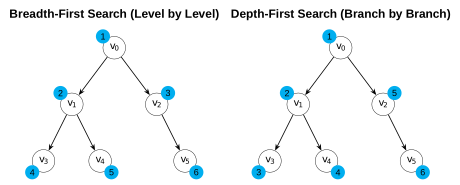
Visual Comparison: Traversal Order
The following diagram illustrates the fundamental difference in exploration order between Breadth-First and Depth-First search. The numbers indicate the exact chronological sequence in which vertices are discovered.
Algorithmic complexity
The time complexity for all three traversals (BFS, Iterative DFS, and Recursive DFS) depends entirely on the underlying representation of GraphType:
-
Adjacency List Representations: \(O(|V| + |E|)\). The algorithm strictly evaluates existing edges, making this optimal for sparse graphs.
-
Adjacency Matrix Representations: \(O(|V|^2)\). To find adjacent unvisited vertices, the algorithm must scan the entire \(|V|\)-length matrix row for every visited vertex, shifting the bottleneck from edge evaluation to row traversal.