Spanning Trees
What is a Minimum Spanning Tree?
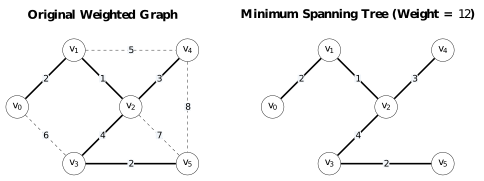
A Spanning Tree is a subset of a graph that is a tree containing all vertices of the original graph. Because it has no cycles and connects every vertex, a spanning tree of a connected graph with \(|V|\) vertices will always contain exactly \(|V| - 1\) edges.
In an edge-weighted graph, multiple spanning trees can exist. A Minimum Spanning Tree (MST) is the specific spanning tree that minimizes the total sum of its edge weights.
Prim's Algorithm Overview
Prim's algorithm is a highly efficient, "greedy" algorithm used to find the Minimum Spanning Tree of a connected, undirected graph.
The algorithm builds the tree one vertex at a time, operating on the following core principle:
- Initialize: Start at any arbitrary "root" vertex. Mark it as visited.
- Evaluate: Look at all edges connecting the currently visited vertices to the unvisited vertices.
- Expand: Select the edge with the lowest weight among edges that connect an already visited vertex to a yet unvisited vertex. Add that edge (and the unvisited vertex it leads to) to the MST.
- Repeat: Continue this process until all vertices in the graph have been visited.
By always making the locally optimal choice (picking the cheapest available edge out of the growing tree), Prim's algorithm is mathematically guaranteed to find the globally optimal Minimum Spanning Tree.
Because graph representations can vary drastically in density (sparse lists vs. dense matrices), a single algorithmic approach cannot guarantee optimal performance across all topologies. To uphold its zero-cost philosophy, CPP-GL provides two highly optimized, standalone implementations of Prim's algorithm tailored for specific memory models.
Both algorithms return a gl::algorithm::mst_descriptorweight and a std::vector of the edges that form the tree.
Edge-Heap Prim's Algorithm
The edge_heap_prim_mst implementation utilizes a standard binary min-heap (std::priority_queue) to store and evaluate discovered edges based strictly on their individual weight.
As the tree expands, the algorithm evaluates all edges incident to the newly added vertex. If an edge leads to a vertex that is not yet part of the MST, the entire raw edge descriptor is pushed directly into the heap.
Example Usage
auto mst = gl::algorithm::edge_heap_prim_mst(graph, start_id); // (1)!
std::cout << "Total MST Weight: " << mst.weight // (2)!
          << "\nEdges: "
          << gl::io::muliline_set_formatter(mst.edges)
          << '\n';
- Computes the MST starting from the given start_id. If gl::invalid_id is passed, it automatically defaults to the graph's initial_id.
- Prints the accumulated minimal weight of the spanning tree and the raw edge descriptors that form the tree.
Algorithmic Complexity
The time complexity is bounded by the heap operations performed on the edges: \(O(|E| \log |E|)\).
- Adjacency List Representations: In simple graphs, this simplifies to \(O(|E| \log |V|)\). However, because list models natively support multigraphs (parallel edges), the queue size and operations scale strictly with \(O(|E|)\).
- Adjacency Matrix Representations: Matrices require scanning the entire \(|V|\)-length row to find incident edges, altering the complexity to \(O(|V|^2 + |E| \log |V|)\).
When to use:
This is the optimal choice for Sparse Graphs (where \(|E|\) is much closer to \(|V|\) than \(|V|^2\)). It is highly recommended for Adjacency List models, especially when the topology contains parallel edges.
Vertex-Heap Prim's Algorithm
The vertex_heap_prim_mst implementation avoids queueing edges entirely. Instead, it maintains a strictly sized array of vertex IDs, where the priority is defined by the minimum known connection cost to that vertex.
Because standard C++ binary heaps do not natively support a decrease_key operation, this implementation dynamically manages a raw std::vector using std::make_heap and std::pop_heap. Whenever a cheaper path to an unvisited vertex is discovered, the connection cost is updated, and the entire heap is rebuilt in \(O(|V|)\) time to re-establish the invariants.
Example usage:
auto mst = gl::algorithm::vertex_heap_prim_mst(graph, start_id); // (1)!
std::cout << "Total MST Weight: " << mst.weight // (2)!
          << "\nEdges: "
          << gl::io::muliline_set_formatter(mst.edges)
          << '\n';
- Computes the MST starting from the given start_id. If gl::invalid_id is passed, it automatically defaults to the graph's initial_id.
- Prints the accumulated minimal weight of the spanning tree and the raw edge descriptors that form the tree.
Algorithmic Complexity
Due to rebuilding the heap (an \(O(|V|)\) operation) up to \(|V|\) times, combined with evaluating every edge, the strict overall time complexity is \(O(|V|^2 + |E|)\).
- Adjacency Matrix Representations: Because matrix models inherently represent simple graphs (where \(|E| \le |V|^2\)), the edge traversal is completely absorbed, and the complexity strictly simplifies to a guaranteed \(O(|V|^2)\).
- Adjacency List Representations: For multigraphs, the edge count \(|E|\) can far exceed \(|V|^2\), meaning the edge traversal phase will bottleneck the performance.
When to use:
This is the optimal, zero-cost choice for Dense Graphs (where \(|E| \approx |V|^2\)). It is strictly recommended for Adjacency Matrix models, as it completely eliminates the overhead of tracking an \(O(|E|)\) sized queue.