Topological Algorithms
Topology solvers are algorithms designed to evaluate, validate, or compute the structural properties of a graph. Rather than finding a path or a sub-tree, these algorithms analyze the global layout of the vertices and edges to determine if the graph satisfies specific mathematical constraints.
CPP-GL provides highly optimized solvers for Bipartite Coloring and Topological Sorting.
Cycle Detection and Failure States
Both bipartite coloring and topological sorting rely on the graph being free of certain types of cycles (odd-length cycles for bipartite graphs, and any directed cycle for DAGs).
Instead of throwing exceptions when a topology violation is encountered, CPP-GL elegantly handles these structural failures by returning a std::optional.
If the algorithm detects a cycle that violates the required topology, the search immediately aborts and returns std::nullopt. This allows you to safely use these algorithms as structural validators in your control flow.
Bipartite Coloring
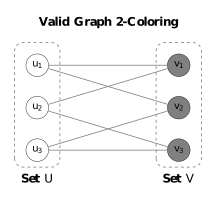
A bipartite graph (or 2-colorable graph) is a graph whose vertices can be divided into two disjoint sets such that every edge connects a vertex in one set to a vertex in the other. In other words, there are no edges connecting vertices of the same color.
The bipartite_coloring algorithm utilizes the generic bfs engine to traverse the graph and strictly alternate colors between adjacent vertices.
Example Usage
if (auto coloring = gl::algorithm::bipartite_coloring(graph)) { // (1)!
    gl::algorithm::apply_coloring(graph, *coloring); // (2)!
    std::cout << "Successfully 2-colored the graph!\n";
}
else {
    std::cout << "Graph contains an odd cycle and is not bipartite.\n";
}
Simple Validation
If you only need to check if a graph is bipartite without extracting the actual color map, you can use the lightweight is_bipartite convenience wrapper, which returns a simple boolean.
Algorithmic Complexity
The time complexity depends on the underlying representation of GraphType:
- Adjacency List Representations: \(O(|V| + |E|)\).
- Adjacency Matrix Representations: \(O(|V|^2)\). Iterating over adjacent vertices requires scanning the entire \(|V|\)-length matrix row.
Topological Sort
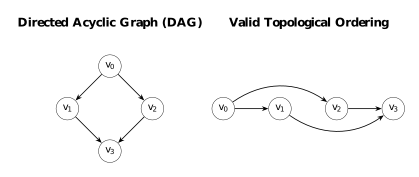
A Topological Sort is a linear ordering of the vertices in a Directed Acyclic Graph (DAG) such that for every directed edge \((u, v)\) (\(u \rightarrow v\)), vertex \(u\) comes before vertex \(v\) in the ordering. This is commonly used for resolving dependency trees, task scheduling, or build systems.
The topological_sort function uses Kahn's Algorithm. It seeds a bfs queue with all vertices that have an in-degree of 0 (no incoming edges). As it processes vertices, it dynamically decrements the in-degrees of their adjacent neighbors.

Example Usage
if (auto top_order = gl::algorithm::topological_sort(graph)) { // (1)!
    std::cout << "Topological Order: "
              << gl::io::range_formatter(top_order.value(), " -> ", "", "") // (2)!
              << '\n';
}
else {
    std::cout << "Dependency cycle detected! Graph is not a DAG.\n";
}
- Attempts to compute the ordering. If the final sorted sequence does not contain all vertices in the graph, it mathematically proves the presence of a cycle. The algorithm then safely returns
std::nullopt. - Prints the topologically sorted
std::vector<id_type>using the range_formatter helper.
Algorithmic Complexity
The time complexity depends on the underlying representation of GraphType:
- Adjacency List Representations: \(O(|V| + |E|)\).
- Adjacency Matrix Representations: \(O(|V|^2)\). Iterating over adjacent vertices requires scanning the entire \(|V|\)-length matrix row.